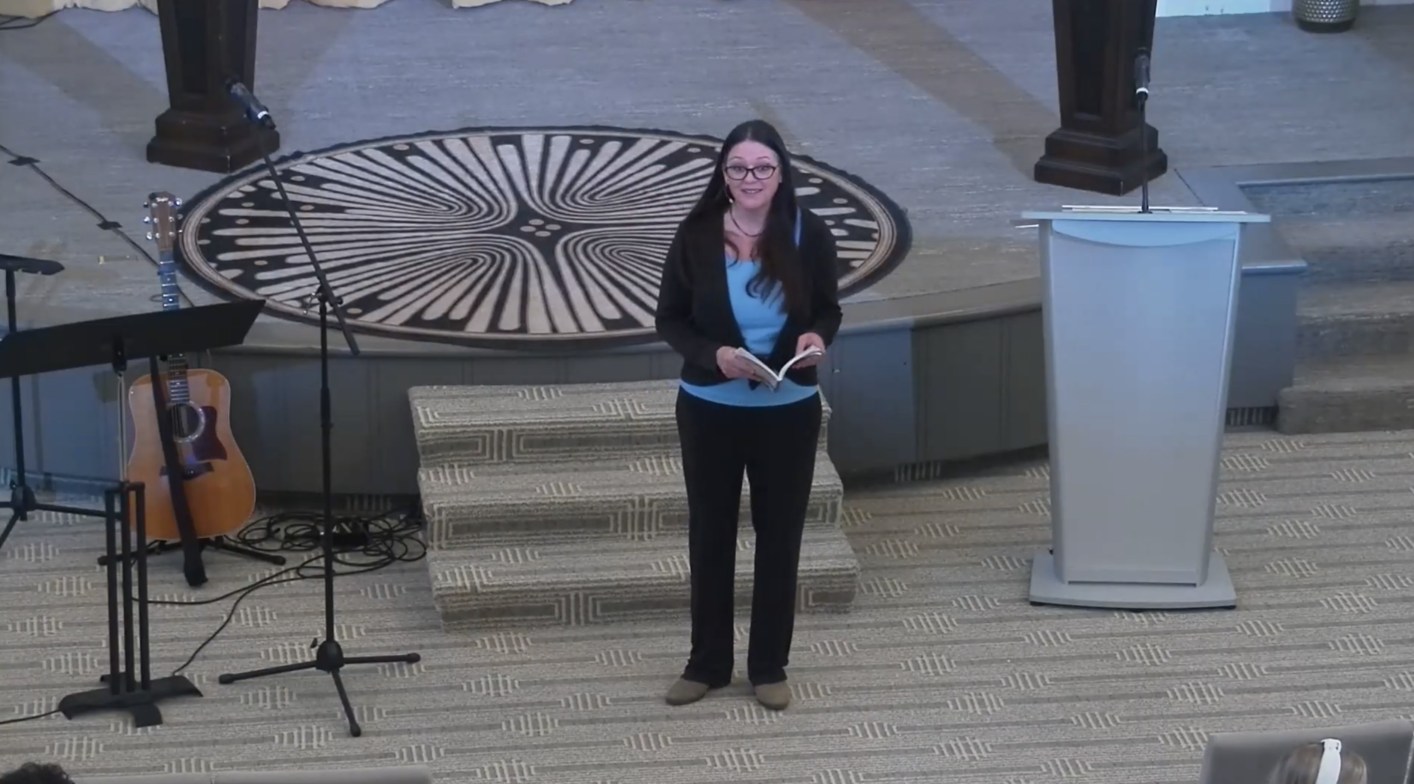
This week at Unity Village Chapel, Rev. Erin McCabe invited the congregation into a holy paradox: to look honestly at the world as it is — and to root ourselves in the deeper truth of what is possible.
She began by dedicating the service to UVC congregant Lindsay, who, in Rev. Erin’s words, is now in her “freedom form.” With tenderness, she reminded us that even in loss, love expands.
“Lindsay, you are in your freedom form. We acknowledge that you have lifted out of your earth suit and into a new realm… We see you. We bless you. We love you.”
In that sacred moment, grief and hope stood side by side. We were reminded that we are more than our physical forms — that life continues, that love expands, and that community holds us through every transition.
God Is Love — Even Now
Rev. Erin named what many of us feel: these are not small times. The world feels intense, uncertain, even overwhelming. And yet, she reminded us that crisis is also fertile ground.
“These are no small times. This time is ripe. Not just because it’s ripe with crisis, but because when something is ripe with crisis, it’s also ripe with possibilities.”
Drawing from Eric Butterworth’s Spiritual Economics, she explored the theme of security in a changing world — a timely reflection as we enter the Lenten season, 40 days of spiritual preparation, release, and transformation.
Butterworth challenges a deeply human instinct: the pursuit of security above all else. We rearrange the outer world — finances, structures, systems — believing that if we can just build enough safety, we’ll finally feel at peace.
But what if that instinct, taken too far, creates its own confinement?
“The most secure place to be is in a prison — maximum security, minimum freedom.”
Rearranging the Inner
Rather than rearranging the outer world in search of “enough,” Rev. Erin called us inward.
“Rearrange the inner. Breathe into the inner sanctuary and open the floodgates — the floodgates of creativity, the floodgates of ideas, the floodgates of unity.”
So often, we avoid looking at what isn’t working — in our systems, our relationships, even ourselves — because it feels too big, too painful, too overwhelming.
But, she said gently and clearly:
“If we can’t see it, we can’t heal it.”
The spiritual path is not about bypassing reality. It’s about facing it — without surrendering to hopelessness. It’s about remembering that beneath the human condition is a spiritual condition: a divine impulse that powers everything.
Security or Creativity?
Butterworth writes that the greatest desire for many people is security. Yet he quotes a professor who suggests that any view of life that puts security above creativity “has misread life at its best.”
Rev. Erin unpacked this tension:
-
Human nature seeks safety, fences, guarantees.
-
Divine nature seeks expression, growth, expansion.
“Life is for expressing, for growth, for expansion.”
When we cling too tightly to safety, we may stifle the very growth we long for. We may even create invisible prisons — systems, habits, fears — that confine us.
And yet, there is another way.
Inlet and Outlet
We are not meant to hoard life. We are meant to circulate it.
“We are an inlet and an outlet of all that is God.”
When we export our power to external structures — bank accounts, institutions, circumstances — we forget that creativity flows from within. The divine is not limited. There is no opposite to God. The source is infinite.
True security, Rev. Erin suggested, does not come from accumulation. It comes from anchoring in Spirit.
“The best way to be safe is never to be secure.”
To live divinely is not to stop planning or preparing — it is to remember that our ultimate supply is spiritual, not circumstantial.
Between Opportunities
As the service drew toward prayer, Rev. Erin offered an affirmation adapted from Butterworth — shifting from “I” to “we,” reminding us that we do not walk this path alone.
“We accept the reality of the difficulties but not as permanence. We are not at the end of anything. We are simply between opportunities.”
Between opportunities.
What if that’s where we are — personally, collectively, globally? Not at the end. Not in collapse. But in the fertile space between what was and what is becoming.
She closed with a powerful declaration:
“Something wonderful is on its way to us, in us, through us, and as us, as creation — far surpassing anything we have ever known before.”
A Practice for the Week
As we move through this Lenten season, consider:
-
Where have I been seeking security at the expense of creativity?
-
What am I afraid to look at — and how might Spirit meet me there?
-
Where am I being called to move from confinement into expression?
Take a breath. Close your eyes to the outer world for a moment.
Remember: you are life, intelligence, and substance expressing.
And together — in unity — we are not at the end of anything.
We are simply between opportunities.
And so it is. Namaste.